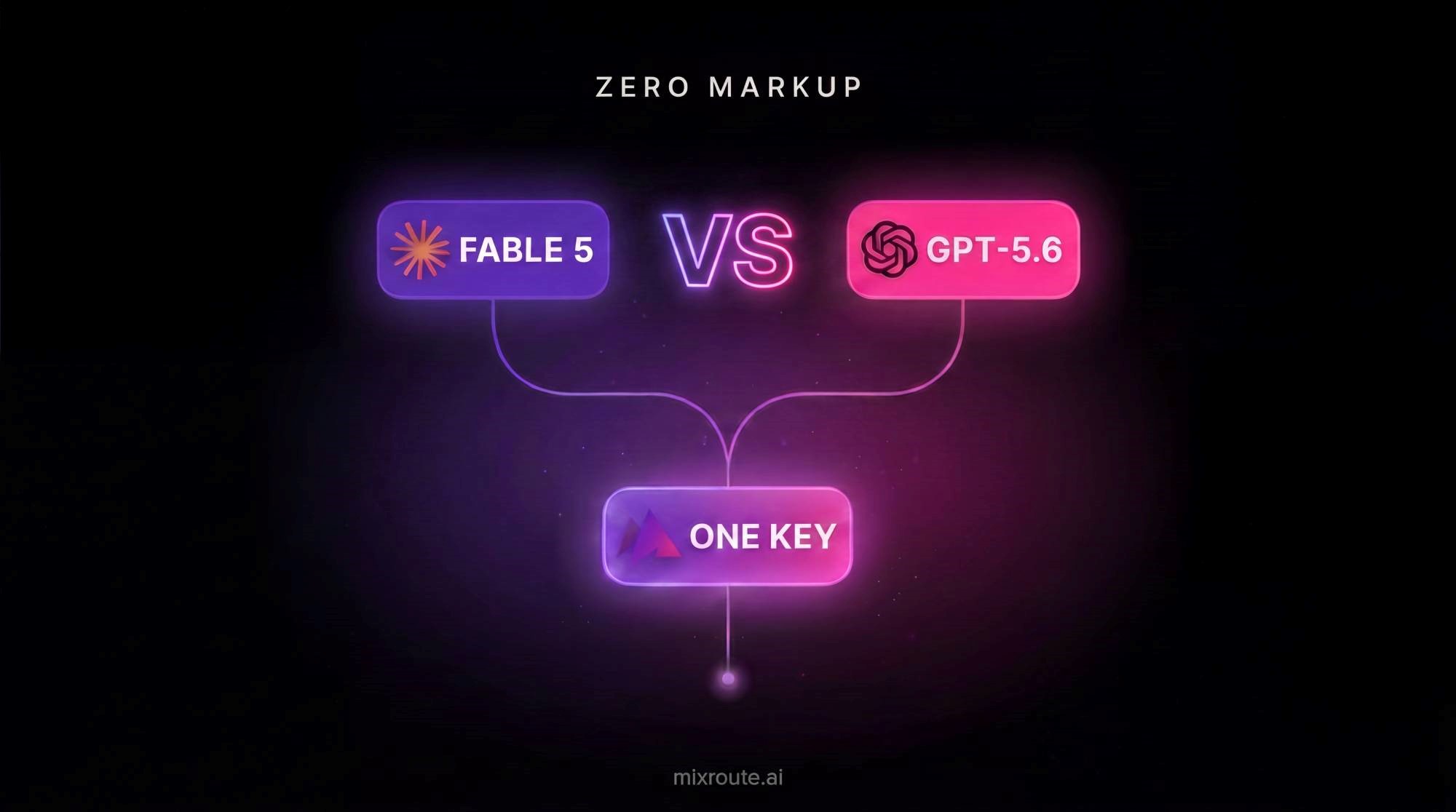
By: TechVanguard – SeaPRwire – Developers face a real headache these days. Top AI models come from different labs. Each requires its own account, separate billing, and constant API key management. Teams waste hours switching contexts or paying extra just to test the best tool for a specific job. MixRoute just cut through that mess. The platform confirmed support for Anthropic’s Claude Fable 5, already live, and promised OpenAI’s GPT-5.6 family as soon as it hits general availability. One key. One payment. Access to both.
The details matter. OpenAI previewed GPT-5.6 on June 26, 2026. Initial access went to a small group of partners. Wider release sits weeks away. The family splits into three modes. Sol handles the toughest challenges. Terra manages high-volume business work with balance. Luna delivers speed and lower costs for routine tasks. Sol stands out as the direct rival to Anthropic’s strongest offerings. Independent benchmarks show no clean winner. GPT-5.6 Sol leads on Terminal-Bench 2.1. Claude Fable 5 holds the edge on SWE-Bench Pro. Each model excels in different work types. Teams gain the most by using both instead of locking into one provider.
MixRoute built its service around this reality. A single top-up covers Claude Fable 5 today and GPT-5.6 tomorrow, plus over 200 other models. Pricing matches official rates with zero markup. No need for separate OpenAI or Anthropic subscriptions. Reserved capacity cuts rate-limit headaches. Consolidated billing replaces multiple invoices. Alan Lu at MixRoute put it clearly. The frontier no longer belongs to one model from one lab. Sol and Fable 5 shine in different areas. Forcing a single provider leaves capability behind. The platform lets teams pick the right model per task without extra costs or admin work.
This shift changes daily operations for engineering groups. Picture a product team in a mid-size startup. They run complex coding tasks where Fable 5 delivers reliable results on software engineering benchmarks. Then they hit a hard reasoning problem that needs Sol’s strength. Before MixRoute, someone would log into two dashboards, track two budgets, and explain two invoices at month end. Now they stay in one endpoint. Calls route to whichever model fits best. That saves time and reduces errors from context switching.
Larger enterprises face bigger versions of the same issue. Procurement teams once negotiated separate deals with OpenAI and Anthropic. Finance departments reconciled multiple vendor payments. Security reviews covered multiple access points. MixRoute collapses those layers. Developers call the same OpenAI-compatible endpoint they already know. Backend handles routing and billing. Teams experiment across frontiers without new contracts. The practical result is faster iteration and lower overhead.
Benchmark splits highlight why this matters. Sol tops certain coding evaluations. Fable 5 performs better on others. No single model dominates everything yet. Smart teams treat them as complementary tools rather than rivals. MixRoute turns that observation into infrastructure. Users switch between models with minimal code changes. The unified gateway removes friction that previously discouraged multi-provider strategies.
Alan Lu’s comment captures the shift. Forcing developers to choose one ecosystem wastes potential. Different models solve different problems better. MixRoute exists to close that gap at official prices. Existing users will access GPT-5.6 through their current setup once OpenAI opens it publicly. No new keys. No extra setup.
The business model also stands out. Zero markup means costs stay predictable. Teams avoid hidden fees that aggregator platforms sometimes add. Reserved capacity helps during peak usage when rate limits bite hardest. Consolidated billing simplifies accounting. These details add up for companies running serious AI workloads.
Consider a development manager juggling quarterly deliverables. One sprint needs heavy creative reasoning where Fable 5 shines. Another requires raw computational power that Sol handles cleanly. Previously, that manager tracked usage across platforms and worried about surprise bills. With MixRoute, the team focuses on outcomes instead of admin work. They route tasks intelligently and keep spending transparent.
This approach points toward a broader change in how AI infrastructure works. Providers compete on model quality. Platforms like MixRoute compete on access simplicity. Developers win when they can ignore the boundaries between labs. The single top-up model removes artificial barriers that slow adoption.
Of course, success depends on execution. MixRoute must maintain low latency across providers. Reliability during high demand will matter. Yet the core promise addresses a genuine pain point many teams feel today.
The move signals maturity in the AI ecosystem. Frontier models from different labs now coexist more easily. Teams no longer face an all-or-nothing choice. They pick the best tool for each job and keep their workflow intact.
Author bio: TechVanguard, senior commentator for international tech publications with over 15 years covering AI infrastructure and developer tools.
source https://newsroom.seaprwire.com/press-releases/technologies/why-smart-dev-teams-are-finally-dropping-the-provider-loyalty-game/