SAN FRANCISCO, CA – 26/02/2026 – (SeaPRwire) – As immersive computing transitions from experimental innovation to enterprise necessity, organizations across North America are re-evaluating how digital assets are created, refined, and deployed. In response to increasing demand for production-ready 3D geometry, Tripo AI has expanded the U.S. rollout of its generative infrastructure while advancing adoption of its Tripo 3.0 framework among major industry clients.
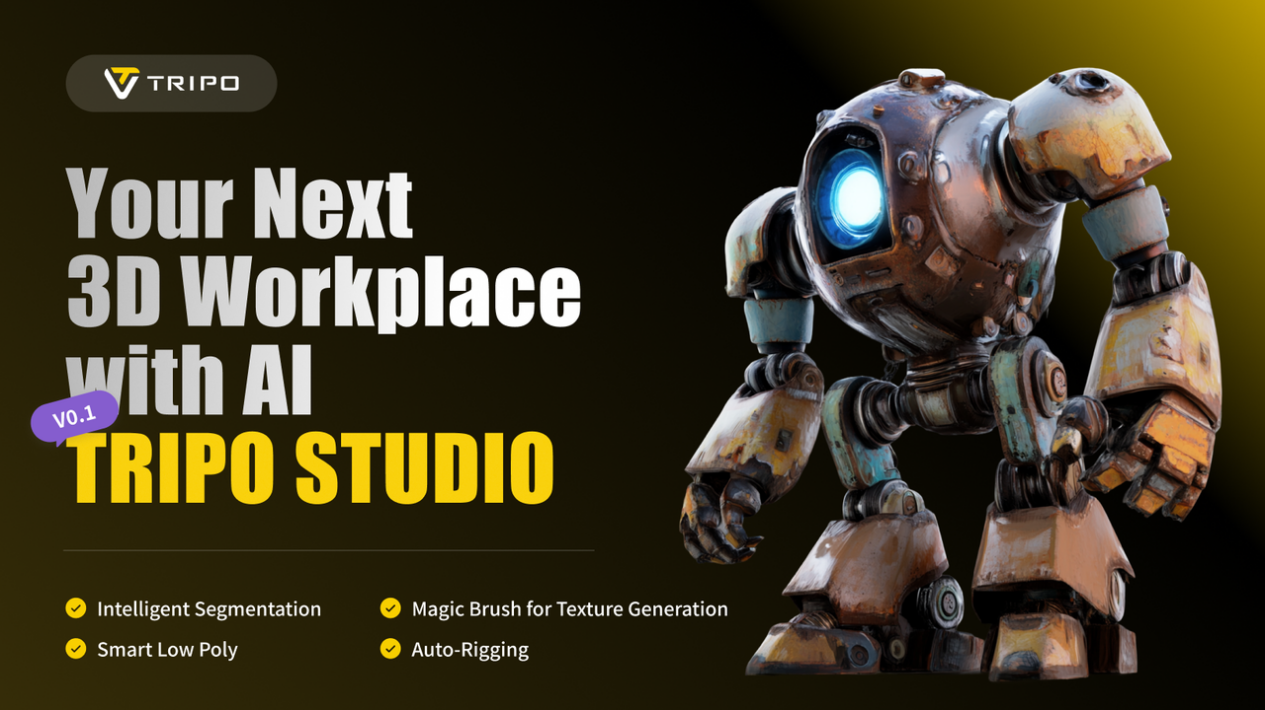
The company’s latest deployment reflects a broader structural shift in development pipelines: enterprises are seeking automated systems capable of translating 2D concepts into editable, high-fidelity 3D models without sacrificing geometric integrity. By prioritizing algorithmic precision, mesh stability, and interactive topology control, Tripo AI aims to standardize automated 3D workflows for commercial-scale applications.
Executive Overview
The acceleration of spatial computing in 2026 has intensified pressure on asset pipelines traditionally dependent on manual modeling. Tripo AI’s enterprise-oriented framework addresses this constraint through neural architecture designed to generate structurally sound meshes and high-resolution materials at scale.
The platform enables rapid conversion from image-based inputs to fully realized topological 3D assets, supporting industries including gaming, industrial design, e-commerce visualization, and immersive training environments.
Key Highlights
- Algorithmic Capacity: Core generative engine built on a model exceeding 200 billion parameters, optimized for advanced geometric logic.
- Speed to Output: Standard white mold generation completed in approximately 20 seconds.
- Global Reach: Serving more than 6.5 million creators worldwide and over 40,000 active developers.
- Enterprise Integration: Adopted by 700+ industry clients for scalable spatial computing applications.
- Industry Evolution: Production-Ready AI 3D Model Generation
In 2026, generative 3D solutions are evaluated not by novelty, but by production viability. Modern rendering environments demand clean topology, logical edge flow, and physically accurate material mapping.
Tripo AI addresses these requirements through an AI 3D model generation framework engineered for geometric consistency and workflow compatibility. According to Simon, Founder and CEO of Tripo AI, the spatial computing era requires dependable infrastructure capable of delivering editable assets at enterprise scale.
By stabilizing automated mesh generation, the system enables technical artists to shift focus from foundational blocking tasks to advanced detailing and aesthetic refinement.
- Technical Architecture: Advancing Image-to-3D Conversion
One of the core challenges in automated 3D creation is transforming flat pixel inputs into mathematically coherent volumetric structures. Tripo AI’s proprietary algorithms are designed to preserve structural integrity during the image-to-3D conversion process.
Operating on a model exceeding 200 billion parameters, the system supports advanced texture mapping and high-definition material outputs. Users can upscale assets to 4K resolution, ensuring compatibility with high-end gaming engines, virtual reality environments, and spatial computing platforms requiring close-proximity rendering fidelity.
- Creator Enablement: Interactive Control Through Tripo Studio
Recognizing that generative outputs require human refinement, Tripo AI provides differentiated interfaces for varying professional needs.
For rapid conceptualization, a Lite environment offers accessible foundational outputs. For enterprise workflows, the company offers Tripo Studio, an advanced online 3D workspace equipped with professional-grade tools. Features include topology adjustment, mesh refinement, part segmentation, hole completion, and support for Physically Based Rendering (PBR) materials.
This hybrid model—automation combined with granular editing—transforms generated meshes into production-ready assets suitable for immediate engine integration.
- Pipeline Automation: Auto-Rigging and API Scalability
To support dynamic applications, generated assets must extend beyond static geometry. Tripo AI incorporates automated rigging functionality that analyzes structural geometry, identifies logical joint placement, and applies standardized skeletal hierarchies. This significantly accelerates animation workflows, enabling rapid application of motion capture or manual keyframe sequences.
From an enterprise integration perspective, the platform’s infrastructure is engineered for high concurrency. Its scalable API framework allows third-party software providers and large organizations to embed 3D generation capabilities directly into proprietary systems, facilitating the expansion of user-generated content (UGC) ecosystems.
- Competitive Landscape Assessment
The U.S. generative 3D sector in 2026 features varied technical strategies tailored to distinct production priorities. Industry observers note that while certain platforms emphasize advanced texture synthesis or video-based reconstruction, Tripo AI differentiates itself through rapid geometric stabilization and post-generation interactivity.
This focus on editable base assets reduces the need for extensive manual retopology before deployment in commercial engines, streamlining integration across enterprise pipelines.
- Outlook: Infrastructure for the Spatial Web
As immersive digital environments scale, automated 3D asset generation is expected to become a foundational component of enterprise infrastructure. Tripo AI’s integrated ecosystem—combining rapid generation, professional refinement tools, animation readiness, and API scalability—positions the company as a technological layer supporting the next phase of the spatial web.
Through continued algorithmic optimization and integration with established industry software, the company aims to broaden access to high-quality 3D creation while maintaining standards required by professional developers.
About Tripo AI
Tripo AI is an artificial intelligence company focused on developing universal large-scale 3D models. The company builds accessible 3D content creation tools designed to support a comprehensive 3D user-generated content ecosystem, positioning spatial computing as a central component of digital productivity and immersive user experience.
source
https://newsroom.seaprwire.com/technologies/tripo-ai-scales-enterprise-grade-3d-generation-platform-across-u-s-market/



 consolidates attribution data, experimentation results, and industry benchmarks into a unified decision-making system. The platform supports marketers in evaluating performance across both direct-to-consumer and wholesale channels, delivering end-to-end clarity across the full marketing funnel.